| Step 12: Visit your doctor regularly |
|


You should continue to visit your doctor regularly to check how well your asthma is being controlled. In general, even patients with intermittent asthma should see their doctor about every 6 months. Those patients with more severe asthma usually need to be seen more often.
To prepare for each doctor's visit:
- Answer the questions in the quiz, Is Your Asthma Under Control?
- Bring your inhaler, spacer, medicines, and peak flow meter with you, so your doctor or nurse can watch your technique.
- Bring your daily record chart, which has the peak flow values you wrote down, symptoms you had, and other factors that affected your asthma.
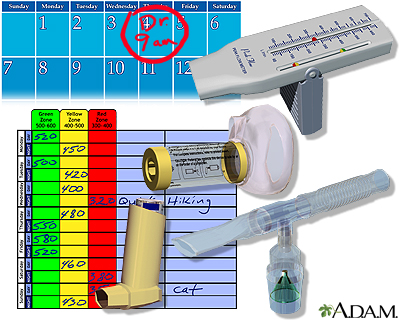
One of your doctor's goals is to find the optimal level of medication needed to keep your asthma under control. If your medications are lowered to a point where your symptoms return, then they will usually need to be bumped back up a little. This is why it can be so helpful for you to keep a daily record chart. A chart helps you keep track of how well you did as your medications were adjusted.
Based on the results of the visit and how you answered the questions, the doctor may need to adjust your medication and give you new written instructions (a new action plan).
 |
|
Who should you see?
Asthma can be managed by a pediatrician, family doctor, or primary care provider. Allergists and respiratory specialists have specific training in the care of asthma and in some cases may be more familiar with current clinical guidelines, such as the National Institutes of Health asthma guidelines. Some patients may wish to go to an allergist or other specialist for a second opinion or to get the initial treatment plan established.
There are times you probably should see an allergist or respiratory specialist for an evaluation. These include:
- You have had asthma attack that put you in the hospital.
- Your treatment plan does not bring your asthma under control after 3 weeks - 6 months.
- You have other conditions that complicate a diagnosis (such as sinusitis, nasal polyps, severe allergies, vocal cord dysfunction, gastroesophageal reflux, bronchitis, or emphysema).
- Additional testing is required (for example, for allergy shots).
- You have "severe persistent" asthma, require continuous high-dose inhaled steroids, or have had more than two treatments with oral steroids in the past year.
- The patient is 3 years old or under and has moderate-to-severe asthma.
Regardless of whether you see a specialist or not, find a doctor who is interested in working with you as a team player. Try to keep track of important information in your daily log, so your doctor will be better able to help you. Remember -- asthma is a condition that can be managed!
Reference
National Asthma Education and Prevention Program Expert Panel Report 3: Guidelines for the Diagnosis and Management of Asthma. Rockville, MD. National Heart, Lung, and Blood Institute, US Dept of Health and Human Services; 2007. NIH publications 08-4051.
 |
|


|
Review Date:
6/29/2012 Reviewed By: Allen J. Blaivas, DO, Clinical Assistant Professor of Medicine UMDNJ-NJMS, Attending Physician in the Division of Pulmonary, Critical Care, and Sleep Medicine, Department of Veteran Affairs, VA New Jersey Health Care System, East Orange, NJ. Review provided by VeriMed Healthcare Network. Previoulsy reviewed by David A. Kaufman, MD, Section Chief, Pulmonary, Critical Care & Sleep Medicine, Bridgeport Hospital-Yale New Haven Health System, and Assistant Clinical Professor, Yale University School of Medicine, New Haven, CT. Review provided by VeriMed Healthcare Network. (6/1/2010) |
 All rights reserved.