Truncus arteriosus
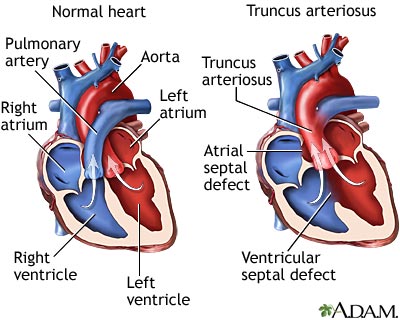
Normally the aorta arises from the left ventricle and the pulmonary artery arises from the right ventricle. In truncus arteriosus both vessels are combined into one vessel. A hole between the two ventricles is usually also present. As a result, unoxygenated and oxygenated blood mix completely. This causes too much blood to be sent to the lungs and not enough oxygenated blood to get to the heart and the rest of the body.

|
Review Date:
10/1/2025 Reviewed By: Thomas S. Metkus MD, PhD, Associate Professor of Medicine and Surgery, Johns Hopkins University School of Medicine, Baltimore, MD. Also reviewed by David C. Dugdale, MD, Medical Director, Brenda Conaway, Editorial Director, and the A.D.A.M. Editorial team. |
The information provided herein should not be used during any medical emergency or for the diagnosis or treatment of any medical condition. A licensed medical professional should be consulted for diagnosis and treatment of any and all medical conditions. Links to other sites are provided for information only -- they do not constitute endorsements of those other sites. No warranty of any kind, either expressed or implied, is made as to the accuracy, reliability, timeliness, or correctness of any translations made by a third-party service of the information provided herein into any other language. © 1997-
A.D.A.M., a business unit of Ebix, Inc. Any duplication or distribution of the information contained herein is strictly prohibited.
© 1997-
 All rights reserved.
All rights reserved.