


Cesarean section
Introduction
The purpose of this tool is to help you decide whether to have a cesarean section delivery. When making a decision like this, you must balance:
- The reasons for doing the procedure
- The potential health risks, drawbacks, or limitations of the procedure
- Whether alternative procedures may be more appropriate
- Cost
This tool is not a substitute for professional medical care and advice. Work with your doctor to help you make this decision. A second opinion from another doctor may be valuable. Surgery always carries risks, and you should be fully informed about the risks and benefits of this type of surgery. You should also be aware that research evidence is often limited, and the risks of surgery may not be completely understood. For this type of surgery, there is usually no exact right or wrong answer.
Your physician may make certain recommendations to you. However, the final decision about whether to have the surgery rests with you.
What is the surgery?
A cesarean section, also called a C-section, is delivering a baby through an incision in your abdomen. A C-section delivery is performed when a vaginal birth is not possible or is not safe for the mother or child.
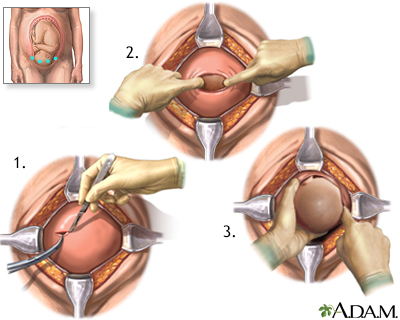
Surgery is usually done while the mother is awake but anesthetized from the chest to the legs by epidural or spinal anesthesia. An incision is made across the abdomen just above the pubic area. The uterus is opened, the amniotic fluid is drained, and the baby is delivered.

Key points
A c-section:
- Is sometimes needed for the health of the mother or baby
- May help avoid injury to the baby during labor
- Avoids injury to your perineum
- Involves rapid delivery of the baby
- May allow you to plan a delivery date
But involves:
- A longer recovery time
- A higher risk of infection in the mother
- A higher risk of blood transfusion in the mother
How much time this decision tool will take
5 - 10 minutes
What this tool will provide
- A personalized list of factors for you to weigh
- Questions to ask your doctor
- Alternatives to this surgery
- Recommended reading
|
Review Date:
9/12/2010 Reviewed By: Linda J. Vorvick, MD, Medical Director, MEDEX Northwest Division of Physician Assistant Studies, University of Washington, School of Medicine. Also reviewed by David Zieve, MD, MHA, Medical Director, A.D.A.M., Inc. |
- Burrows LJ, Meyn LA, Weber AM. Maternal Morbidity Associated With Vaginal Versus Cesarean Delivery. Obstetrics & Gynecology. 2004;103:907-12
- DiMatteo MR, Morton SC, Lepper HS, Damush TM, Carney MF, Pearson M, Kahn KL. Cesarean childbirth and psychosocial outcomes: a meta-analysis. Health Psychology. 1996 Jul;15(4):303-14.
- Dunn EA, O'Herlihy C. Comparison of maternal satisfaction following vaginal delivery after caesarean section and caesarean section after previous vaginal delivery. European Journal of Obstetrics Gynecology and Reproductive Biology. 2005 July;56:121.
- Lydon-Rochelle MT, Holt VL, Martin DP. Delivery method and self-reported postpartum general health status among primiparous women. Paediaticr Perinatal Epidemiology. 2001 July;15(3):232-40.
- McLennan MT, Alten B, Melick C, Hoehn M, Young J. Patients' satisfaction with and attitudes toward vaginal delivery. Journal of Reproductive Medicine. 2005 October;50(10):740-4.
- Ryding EL, Wijma K, Wijma B. Psychological impact of emergency cesarean section in comparison with elective cesarean section, instrumental and normal vaginal delivery. Journal of Psychosomatic Obstetrics and Gynecology. 1998 Sep;19(3):135-44.
- Wu JM, Hundley AF, and Visco AG. Elective Primary Cesarean Delivery: Attitudes Urogynecology and Maternal-Fetal Medicine Specialists. Obstetrics & Gynecology. 2005;105:301-6.
© 1997- A.D.A.M., a business unit of Ebix, Inc. Any duplication or distribution of the information contained herein is strictly prohibited.
 All rights reserved.